


We’re halfway through summer, and whether you’ve been writing steadily since June or haven’t opened your laptop once, there’s still time to find the right program for your work.
Whether you’re a novelist wrestling with a stubborn middle chapter, a poet seeking fresh inspiration, or a memoirist ready to dive deep into personal narrative, the right writing program can offer transformative opportunities. But how do you choose the one that best fits your needs and goals?
Below, we break down the various programs and share tidbits our writers have learned along the way.
Writing Retreats: Deep Dives into Craft
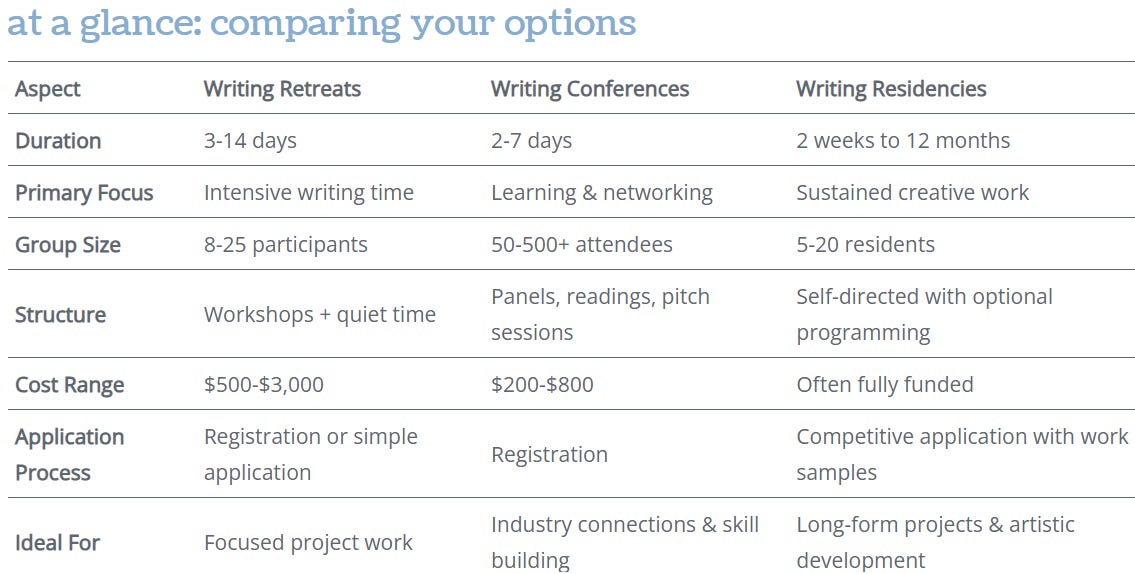
Retreats offer writers the luxury of concentrated time and space to focus solely on their work. These programs typically combine structured workshops with ample quiet writing time, often set in inspiring locations away from daily distractions.
Most retreats follow a rhythm of morning workshops, afternoon writing sessions, and evening readings or discussions. The small size of the group fosters close relationships with both instructors and fellow participants, creating a supportive community that often extends well beyond the retreat itself.
PROS:
Intensive, focused writing time with minimal distractions
Small group settings for personalized attention from instructors
Strong sense of community and lasting connections with other writers
CONS:
Higher cost due to accommodation and meal inclusions
Limited networking opportunities with industry professionals
Shorter duration may not allow for major project completion
From the Field: Writing Retreats
In October 2024, Evelyn Camu, a book inc writer, attended Elizabeth Gilbert’s Big Magic Creativity & Wellness Retreat. She said, “During this retreat, I felt something in me shift. I have more belief in myself, more openness to life and being vulnerable with others, and a connection to new writers that I hope will be lifelong friends.” Read her full story here.
Speaking of retreats, we have one spot left for our own Stick Season Writers Retreat this November 19 to 22 at Prospect Street Writers House in North Bennington, Vermont. Although not a summer retreat, “stick season” has its own kind of magic: bare branches, cold air, and the quiet that comes right before the snow. Four days, six writers, one beautiful house in the Green Mountains. You write, share, walk, talk craft, and eat well, all in the company of writers who get it.
A short application is required, and spots are reviewed on a rolling basis. If you’ve been waiting for a sign to get serious about your work, this is it. APPLY NOW.
Writing Conferences: Learning and Networking Hubs
Writing conferences serve as intensive learning experiences where writers can attend panels, workshops, and readings while networking with peers, agents, editors, and established authors. These events buzz with energy and opportunity, offering everything from craft sessions to pitch appointments.
The conference environment is fast-paced and information-rich, with multiple sessions running simultaneously. Attendees can customize their experience based on their interests and career stage, whether they’re seeking technical craft advice, industry insights, or publication opportunities.
PROS:
Extensive learning opportunities across multiple genres and topics
Direct access to agents, editors, and publishing professionals
Relatively affordable with options for different budget levels
CONS:
Can be overwhelming with too many choices and overstimulation
Limited actual writing time during the event
Large crowds may make personal connections difficult
From the Field: Writing Conferences
In March 2026, a group of book inc writers headed to Baltimore’s Inner Harbor for the Association of Writers & Writing Programs Conference (AWP).
Shanda McManus (Weatherproof) said her biggest takeaway was to write from her own place. “Be yourself first in all your work. Don’t worry about trends or what the industry may want.”
Court Harler found the in-person connection especially meaningful. “Meeting other writers face-to-face can really boost your sense of literary community ... I returned to my desk with renewed energy.”
Read our writers’ full report in the book inc Journal, Charmed in Charm City.
Writing Residencies: Space for Sustained Creation
Writing residencies offer writers the time, space, and often financial support necessary to focus on significant creative projects. These programs range from a few weeks to a full year, offering unstructured time for deep creative work with minimal obligations beyond the writing itself.
Residencies operate on the principle that artists need sustained periods of focus to create their best work. Most provide private studios or writing spaces, and many include accommodations and stipends. The application process is typically competitive, requiring work samples and project proposals.
PROS:
Extended periods of uninterrupted creative time
Often fully funded with stipends, eliminating financial pressure
Prestige and validation through a competitive selection process
CONS:
Highly competitive application process with low acceptance rates
Significant time commitment may not suit all life circumstances
Self-motivation and discipline essential for unstructured time
From the Field: Writing Residencies
In March 2025, PWN’s poetry instructor Jaz. Bloom in the Struggle. attended the Inaugural Thriving Roots Artist Residency.
Of the residency, she said: “I really enjoyed my time at the residency at SIEU because I learned more about investing in myself as a person and artist, and that an imperative part of that investment is rest. Reset and rest are all a part of thriving as a creative.”
Online Writing Accountability Groups: Community from Anywhere
For writers who need consistency more than critique, accountability groups offer something the other programs can’t: a regular, low-pressure touchpoint that keeps you showing up to the page. These groups typically meet on a set schedule, often daily or weekly, and focus less on formal instruction and more on simply protecting the time to write.
The format is simple by design. A brief check-in, a stretch of quiet writing time, and the option to share if you want to. There’s no pitch meeting, no critique circle, no pressure to produce a finished piece. The goal is habit, not output, though plenty of writers find the output follows anyway.
PROS:
Builds a sustainable, low-cost writing habit
Flexible enough to fit into daily life, no travel required
Community and encouragement without the pressure of critique
CONS:
Less structured feedback on craft than a class or workshop
Requires self-direction once the writing time begins
Virtual format means less in-person connection
From the Field: Online Writing Accountability Groups
“I was never a daily writer, and although it frustrated me, I accepted it as who I was. But then I started hosting PWN’s Morning Pages. The fact that I’m in charge of hosting the Zoom forces me to put my butt in the chair every weekday morning. I don’t always get a ton of writing done, but I always get a few words on the page or check off some writing tasks. It’s been so helpful to have that writing hour before the day gets started, especially with all the to-dos associated with a book launch.” - Elizabeth Jannuzzi
If you’re looking for that kind of steady, no-pressure community, Morning Pages runs weekday mornings, Evening Pages offers the same structure for night owls, and Lunchtime Write-In gives you a midday hour every Friday. All are low-cost or pay-what-you-can, and you can join anytime.
Or Consider One of Our Classes and Programs!
If you can’t make it to a retreat, conference, or residency (oh my!), consider a workshop or class offered by us, Project Write Now.
Most of our summer classes are already underway, but there are a few spots left in a couple of classes. If you hurry, you can join our six-month Lit Mag Submission Club starting tomorrow, July 21, and fall classes in memoir, personal essay, family history, and more open for registration soon—both virtual and in-person. Check out PWN’s Course Catalog with more classes getting posted soon.
If you want to write or revise a book, book inc’s next Incubator and Book Revision Lab sessions begin in January 2027. It’s not too early to start planning. Learn more about book inc’s programs here.
From the Field: Project Write Now Classes or book inc Programs
Of the Book Revision Lab, PWN flash instructor Liz deBeer said, “The feedback I received in the Book Revision Lab was so helpful. The line edits and comments were both critical and supportive. The guidelines made the whole process inviting.”
Pick Your Summer (And Beyond) Writing Adventure
The perfect writing program depends on your current needs, project goals, and personal preferences. Consider what you hope to gain: concentrated writing time, industry connections, new skills, or simply the inspiration that comes from being surrounded by other passionate writers.
Your stuff gets more wonderful as you go on!
This is such an essential and enriching article...thanks PWN! And I appreciate the inclusion of my experience as well :-)